
Mobile clinics are transforming healthcare by meeting people where they live, work, and learn. Each year, millions of patients across the United States receive care they might otherwise go without, overcoming barriers like cost, transportation, and language differences.
At Mobile Health Map, our data shows that mobile clinics don’t just provide care, they improve lives and save money. By evaluating their impact, clinics can fine-tune services, expand where they are needed most, and ensure every visit makes a real difference in the health and well-being of the communities they serve.
Read our 2025 Landscape Report for the latest insights on the sector, how it’s evolving, and where it’s heading.
Why Evaluation Matters
1. Improving Care Delivery
Evaluation helps mobile clinics see what’s working and what needs improvement. From screenings to vaccinations to mental health services, data on patient outcomes, service utilization, and satisfaction helps teams refine their care. Mobile health evaluation ensures every visit delivers the best possible impact.
2. Proving Impact
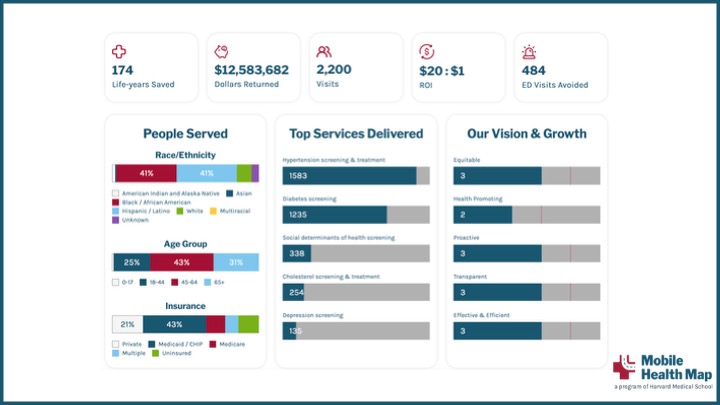
Funders, policymakers, and healthcare leaders want results. Mobile clinics must show measurable outcomes to secure support. Evaluation provides clear evidence of how mobile healthcare reduces health disparities, improves patient outcomes, and expands access to care. Data-backed results build credibility and attract investment for future growth.
Use our free and easy-to-use tools to calculate your return on investment (ROI), and create a mobile clinic dashboard to share your clinic’s impact.
3. Advancing Health Access
Mobile clinics are on the frontlines of health access. They reach underserved populations in rural areas, low-income neighborhoods, and communities facing barriers to traditional care. Evaluation ensures these communities receive the care they need and helps identify gaps where services can improve.
Tools like our Public Health Quality Check-Up can help clinics assess whether their services are reaching the right communities and meeting their needs effectively. It also highlights where disparities might still exist, enabling clinics to take targeted actions to address them.
4. Ensuring Sustainability
Running a mobile clinic requires resources, funding, and partnerships. Evaluation ensures these investments are used efficiently while proving impact, making stakeholder and funding reporting easy. By assessing service effectiveness and operational efficiency, clinics can optimize resources and maintain long-term sustainability. This allows mobile healthcare to continue supporting the communities that depend on these services.
5. Building Community Trust
Mobile health clinics occupy a unique and underrecognized role in building trust. By delivering care directly in neighborhoods, showing up consistently, and centering relationship-based models, mobile clinics often function as trusted intermediaries between communities and health systems. Evaluation promotes transparency and shows that clinics are actively improving services based on real-world results. Stronger trust leads to better engagement and healthier communities.
How Data Drives Better Mobile Healthcare
At its core, mobile health evaluation is about data. Clinics track patient demographics, monitor chronic disease trends, measure treatment effectiveness, and reach underserved areas. Insights from this data guide smarter decisions, more targeted care, and stronger outcomes.
But it’s not just about numbers. Evaluation also captures the human side of mobile healthcare — patient stories, experiences, and community needs. Understanding these narratives helps clinics provide more compassionate, patient-centered care.
To learn how to capture quality feedback through surveys, see our Survey Best Practices Guide. Insights from this process guide smarter decisions, more targeted care, and stronger outcomes.
Ready to measure and strengthen your impact?
Mobile clinics are a vital part of the healthcare system, delivering essential care where traditional services fall short. Evaluation ensures mobile clinics are effective, sustainable, and impactful. By measuring outcomes, refining strategies, and sharing results, mobile health teams can continue improving health and advancing health access.
Don’t forget, we are here to help! Use our free tools or connect with our team to get started.