Rural Health Transformation Needs Wheels (Why Mobile Clinics Must Be Included in RHTP!)
Share this
Rural health is at a breaking point. As states finalize their plans under the federal Rural Health Transformation Program (RHTP), Medicaid leaders, rural health offices, and policymakers face a defining question: how will care actually reach people?
According to a recent report by Chartis, more than 40% of rural hospitals are operating at a loss, and 417 are at risk of closure. Over 200 have already closed or stopped providing inpatient care; OB, chemotherapy, and surgery are disappearing from entire regions.
Against this backdrop, the federal Rural Health Transformation Program (RHTP) is injecting $50 billion into rural healthcare over the next five years. It’s an unprecedented investment designed to address “the fundamental hindrances of improvement in rural health care.” (chartis.com)
The reality is rural communities face significant fiscal headwinds. The Kaiser Family Foundation (KFF) estimates that, over ten years, rural areas could see about $137 billion in reductions in federal Medicaid spending alone, as part of broader cuts exceeding $900 billion in Medicaid nationally under the 2025 reconciliation law. The Georgetown Center on Health Insurance Reforms (CHIR) further reports that provisions in H.R. 1 are projected to reduce federal funding to hospitals and other providers by more than $1 trillion overall.
In this context, the RHTP’s $50 billion rural health fund is a powerful but partial counterweight. KFF cautions that directly comparing first-year RHTP allocations with ten-year estimates of Medicaid cuts can be misleading because the timing, distribution, and allowable uses are very different. Even when considered over its full five-year horizon, the RHTP fund remains far smaller than the long‑term reductions rural communities are projected to face. (KFF)
In other words, funding alone won’t save rural health. How states deploy that funding matters just as much as how much there is.
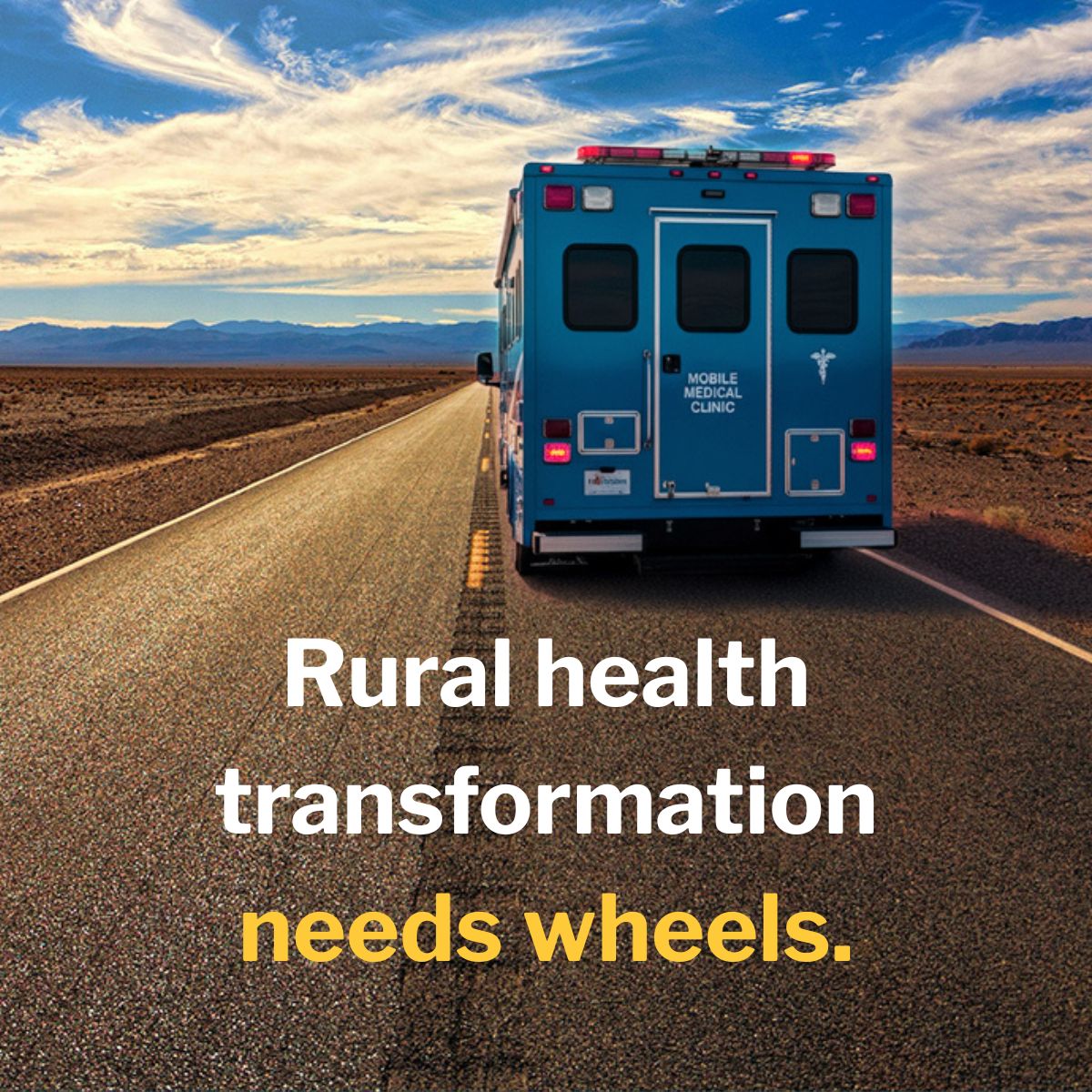
To make RHTP succeed, care must be able to move to farms, schools, church parking lots, and community centers.
That’s where mobile clinics come in.
Mobile Clinics: The Infrastructure We Already Have
Mobile Health Map, a program of Harvard Medical School, serves as the national data and evaluation hub for the mobile health sector. For nearly two decades, we have supported mobile clinics across the country and recently published the 2025 Landscape Mobile Clinic Report which shows:
- 3,600+ mobile clinics in the U.S. (80% growth since 2013)
- 10+ million visits a year
- A patient population that traditional systems often miss: low‑income, uninsured, people experiencing homelessness, and agricultural workers
For rural America:
- 65% of mobile clinics serve rural communities
- Most provide preventive care and primary care
- One in four offers dental services
This isn’t hypothetical infrastructure. It’s already in operation.
CHIR’s recent literature review, synthesizing over 160 studies, confirms what we see in the data: mobile health expands access in rural areas by overcoming geographic distance, broadband limitations, transportation barriers, and workforce shortages. Mobile programs increase preventive care and chronic disease management, link patients to follow‑up care, and consistently report high patient satisfaction. According to our data, mobile health programs also demonstrate reductions in emergency department visits and system‑level cost savings.
In short: mobile clinics already deliver what RHTP says it wants to fund: accessible, equitable, cost‑effective care.
A Blind Spot in Many RHTP Plans
Chartis finds that most RHTP plans emphasize telehealth, Artificial Intelligence, interoperability, and clinically integrated networks. These investments are important and necessary.
But they leave a basic question unanswered: Where, and through whom, will care reach people who can’t or won’t go to a hospital or clinic?
- Telehealth doesn’t work without broadband, privacy, or a trusted human presence to facilitate care.
- AI is irrelevant if there’s no local, point of care.
- Network integration doesn’t automatically reach an older adult who has stopped driving, or a farmworker who cannot afford to lose a day’s pay.
Mobile clinics bring care directly into communities, with teams who build trust over time and translate innovation into real-world care. They not only provide services, but foster relationships, making technology, referrals, and systems integration usable for people whose lives do not fit neatly into traditional healthcare models. Mobile clinics successfully combine both human relationship-based care and highly technical medical capabilities.
CHIR’s review shows that at least 42 states mention mobile health in their RHTP plans, yet few specify how mobile services will be funded, operationally integrated, or sustained beyond short-term infrastructure investment and pilots.
Mobile Clinics Strengthen, Not Replace, Rural Hospitals
This is not an argument against rural hospitals. Mobile clinics are one of the most practical tools available to extend hospital reach, stabilize referral pathways, reduce avoidable emergency department use, and keep care local as inpatient services disappear.
In many rural communities, mobile clinics function as an entry point into the healthcare system, identifying conditions earlier, supporting medication adherence, and connecting patients to fixed-site providers when higher-acuity care is needed. When aligned intentionally, mobile programs help hospitals allocate limited resources where they are needed most.
The Financial Case: High Impact per Dollar
Across mobile programs using Mobile Health Map’s Impact Tracker, mobile clinics demonstrate strong and consistent returns:
- Approximately $18 returned for every $1 invested
- 55,000+ ED visits avoided annually
- Roughly $1.5 billion dollars returned to the healthcare system
- 20,000+ life‑years saved
Service‑specific returns, particularly in maternal health, chronic disease management, and mammography, are even higher.
These gains come from catching disease early, preventing avoidable hospitalizations, supporting medication adherence, and reducing unnecessary ED use.
Both Chartis and KFF warn that while RHTP funds are time‑limited, Medicaid cuts will compound over time, placing increasing strain on rural systems. If every dollar must stretch further, mobile clinics are among the most efficient, evidence‑backed ways to do so.
What States Must Do
States don’t need a new playbook. They need to intentionally elevate mobile health within RHTP implementation, using a systems-level approach that aligns strategy, funding, and delivery:
- Start with systems-level planning and landscape analysis.
Before deploying new funds, states should assess existing mobile health capacity, geographic gaps, hospital vulnerability, workforce availability, and community needs through a coordinated landscape analysis. This type of planning allows states to identify where mobile clinics can stabilize access, complement hospital services, and fill emerging service gaps as rural systems change. - Name mobile explicitly in RHTP plans.
Treat mobile clinics as core infrastructure alongside telehealth, especially in counties with high hospital vulnerability, service loss, and long travel distances. (Chartis)
- Fund mobile networks, not one‑off vans.
Use RHTP dollars to strengthen and expand existing mobile programs by not only investing in vehicles, equipment, but also in 3–5 years of operating support tied to outcomes such as reduced emergency department use, improved chronic disease control, higher screening and vaccination rates, and documented cost savings. Network-based investments allow states to scale impact while avoiding fragmented, short-term pilots.
- Integrate mobile with telehealth, AI, and emerging innovations.
Equip mobile units with broadband, diagnostics, and clinical workflows that connect patients to virtual specialty care, referral networks, and follow-up services, bringing the benefits of digital innovation directly into communities.
- Measure impact from day one.
Standardize evaluation across programs by using tools like Mobile Health Map’s Impact Tracker and Public Health Quality Tool and link mobile health data with hospital, public health, and claims data where possible. Doing so enables states to demonstrate return on investment, support sustainability, and clearly show legislators and communities what RHTP funding is delivering.
CHIR’s policy work reinforces that states treating mobile health as a core delivery strategy, grounded in planning, integration, and evaluation rather than isolated pilots, are best positioned to sustain impact over time.
A Once‑in‑a‑Generation Choice
Chartis describes this moment as a “crossroads” for rural healthcare.
One path focuses primarily on preserving bricks-and-mortar systems, even as services disappear and access gaps widen. The other keeps hospitals as strong as possible while building flexible, community-rooted delivery models that can reach every corner of rural America.
The data is clear. Mobile clinics are:
- Growing rapidly (80% sector growth since 2013)
- Reaching millions of patients who might otherwise go without care
- Delivering measurable returns for health systems and communities
- Supporting workforce development and local job training and pathways
Rural health transformation doesn’t just need more dollars.
It needs wheels.
If you’re exploring how mobile health can be part of your RHT strategy, contact us at MobileHealthMap@hms.harvard.edu